
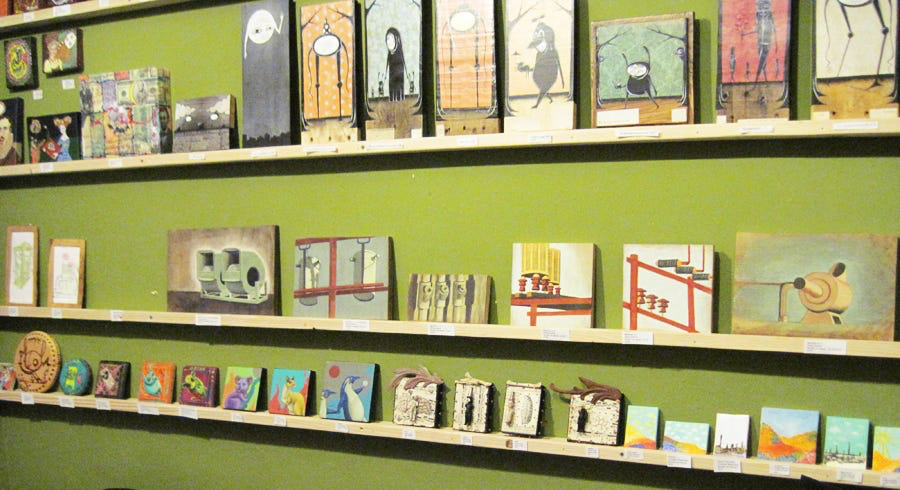
It’s the newly emergent artist conundrum: to get into shows, you need a resume; to have a resume, you need to be in shows. I started my career as an artist thousands of miles from where I attended art school. I had no connections in town. Here are some of the things I did to meet peers and start showing right away.
Don’t knock the internet.
When I first came to town, the only art show applications I had access to were on Craigslist. The first shows I participated in were through calls for art. I hung larger than life nudes at a comedy show. I met an energetic young woman who put on shows at bars and clubs and house parties. Maybe more people should throw an art filled house party. I made my first sale, 7 paintings, in a Venice home. My only real advice is to avoid non established “opportunities” that require you to pay to show.
Follow the spaces you want to show and keep and eye out for ways in.
As I became more familiar with the Los Angeles art scene, I stopped scrolling Craigslist and found other places to watch for opportunities. I joined mailing lists for all kinds of spaces around me; high end galleries, libraries, coffee shops, retail shops that also display art, and neighborhood art walks. This approached added several lines to my resume.
Galleries often host events for charities, and these charities seek art donations for supporters to bid on. Catching these events and donating art for a good cause added 2 galleries to my resume. I recommend supporting operations who give the option of taking only a 50% commission, and who return unsold work. You can decide what cut you want to give, but we have to be careful not to devalue our work along the way.
Start an artists group.
Having an artist group makes you more likely to get the entry level opportunities you apply for. Unconventional spaces seeking art don’t want to coordinate with multiple artists because it’s time consuming. So they’ll opt for the artist group. My art group was able to secure a regular space in a business along an walk and once, we were able to quickly fill a last minute vacancy in a gallery because we had the work ready to fill the space. As a group we efficiently handled everything for the spaces we showed in and we even spackled when we were done. We were called Circa Artists. Having a cool name helps, too.
I really wanted to be a part of a show at a beautiful local library, but my work never fit their calls for art. One day, the city hosted an art fair, and artists who were a part of the fair were invited to hang one work in the library. I submitted my artist group to host a booth at the fair, and we all got a nice new line on our resume.
Put on your own show.
I’ve hung more group shows than I can count, in spaces like hair salons, real estate offices, warehouses, and recording studios. Fellow artists who are just starting out are glad to have an opportunity to show, and are usually happy to help hang and bring some booze for the reception. While living in Atwater Village, I put a show together for artists I met in my neighborhood called “Atwater Village Artists”. It hung for a month at the local wine bar, and Will Sasso even showed up at the reception.
Visit the places you want to show.
You’ve heard this one. But here’s the difference. Don’t just attend openings. Look out for events and find ways to support the space. Attend a portfolio review. Purchase gifts from their shops. Retweet them. Attend figure drawing session. Bring your friends along.
Things you can put on your resume that you may not have considered.
If you went to art school, did your class hang work in a campus gallery? This show can go on your resume. Did you put paintings up in your aunt’s office? I once hung a painting at my dentist’s office. The line on your resume might not get you into the Gagosian, but early in your carreer, a record of relationships and evidence of shows shows gumption, and that’s not a bad thing. It will get you into the next show. Eventually, you will be curating which lines you keep in your resume.
Teaching an art related class is another great way to beef up the resume. It may not be an art show (though it could always lead to one), but it establishes you as an art professional. You can teach online through venues like Skillshare, or, through a barter system like Tradeschool LA. I’ve added things like judging an art walk and speaking about creativity in business to a business 101 class to my resume
Don’t assume you can’t get into something or that you’re not ready.
Looking back, I can see where my assumption that a gallery owner or a curator wouldn’t consider me yet prevented me from showing in the spaces I wanted to sooner. While you shouldn’t expect something from or annoy an art world professional you look up to, don’t let your own assumptions keep you down. I had a couple of opportunities where people were interested in my work, but I told them I wasn’t ready, and would reach out when I was. By the time I was ready, one place had retired, and the other person had forgotten me entirely! I still kick myself. My earlier work wasn’t yet where I wanted it to be, but people responded to it, and looking back, I can see that it was good.
My unconventional art exhibition journey enabled me to get to know the city in a way I never would have otherwise, which informs my art making today. It also introduced me to so many of LA’s underground visual artists and to alternative exhibition spaces, where my work has historically sold better. I know how hard it is to create and sustain an art career by one’s own bootstraps . Fortunately, the people you meet along the way become your contemporaries and over time you rise together.